

If you’ve ever seen a listing for a 100 acres plot and wondered what that number actually means in real life, you’re not alone. Acres are one of those units everyone hears but almost nobody can picture. This guide breaks down 100 acres of land into numbers you can actually visualize, from square feet to football fields, and answers the real question behind the search: is 100 acres a lot, and what could you do with it?
What Is 100 Acres, Exactly?
Here’s the quick answer: 100 acres equals 4,356,000 square feet, or roughly 404,686 square meters. That’s about 0.405 square kilometers, or 40.47 hectares. If you laid it out as a perfect square, each side would stretch just over 2,087 feet, or about four-tenths of a mile.
The acre itself is an old unit, and its origin explains why it’s such an odd number. Centuries ago, an acre described the amount of land area a farmer could plow with a team of oxen in a single day. That’s why it’s not a round number in the metric system. It’s tied to labor and land, not geometry. The unit stuck around in the U.S., the U.K., and a handful of other countries even after most of the world switched to metric land measurement.
So when someone mentions a 100-acre parcel, they’re really talking about a large tract of land, one big enough to hold a small neighborhood, a working farm, or a nature preserve, depending on how it’s used.
100 Acres Converted to Other Units
Converting 100 acres into other units of area measurement makes the number easier to work with, whether you’re comparing property size for a real estate deal or doing homework for a land survey class.
converted to Square Feet
This is the conversion people search for most. One acre equals 43,560 square feet, so:
100 acres = 4,356,000 square feet
That’s the floor area equivalent of roughly 75 average American houses stacked side by side, if you could somehow lay all their footprints flat across the land.
converted to Square Meters
In metric terms, one acre equals about 4,046.86 square meters. Multiply that out and you get:
100 acres ≈ 404,686 square meters
converted to Square Kilometers
Since a square kilometer is a million square meters, the square kilometer conversion works out to:
100 acres ≈ 0.405 km² (0.405 square kilometers)
That’s less than half a square kilometer, which might surprise anyone who assumed “100” of anything sounds enormous.
converted to Hectares
The hectare conversion is one of the cleaner ones, since a hectare is close in size to two and a half acres:
100 acres ≈ 40.47 hectares
converted to Square Miles
A full square mile contains 640 acres, so 100 acres is a small slice of one:
100 acres ≈ 0.156 square miles
Quick Conversion Table
| Unit | Value |
|---|---|
| Square Feet (sq ft) | 4,356,000 |
| Square Meters | 404,686 |
| Square Kilometers | 0.405 |
| Hectares | 40.47 |
| Square Miles | 0.156 |
Keep this table bookmarked. It covers every common area conversion you’ll need when comparing 100 acres to a plot listed in a different unit.
What Does 100 Acres Actually Look Like?
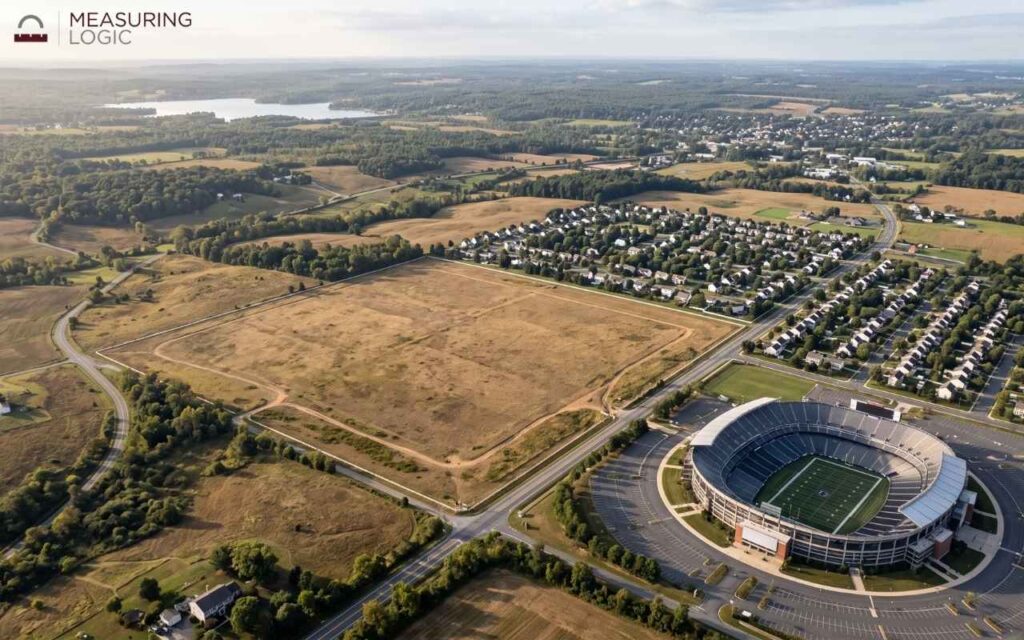
Numbers on a page don’t mean much until you can picture the space. Here’s how to actually see 100 acres.
Picture It as a Square
If you shaped a 100-acre plot into a perfect square, each side would run about 2,087 feet, roughly 636 meters. Walk from one corner to the opposite corner and you’d cover close to 0.56 miles diagonally. That’s a genuinely large land parcel, big enough that you couldn’t easily shout from one edge to the other.
Common Real-World Shapes
Most 100-acre parcels aren’t perfect squares, though. Farmland tends to run in long rectangular strips that follow old survey lines or irrigation systems. Rural properties near rivers or roads often hug the water or the road frontage, stretching narrow and deep instead of square. Suburban development parcels sometimes come in irregular shapes, carved out by whatever boundaries existed before the land got subdivided. The shape matters just as much as the size, because a long, narrow 100-acre parcel feels very different to walk than a compact square one.
100 Acres in Football Fields
This comparison gets used constantly, and for good reason: it works. An NFL football field, end zones included, covers 57,600 square feet. Divide that into 100 acres and you get:
100 acres ≈ 75 football fields
If you only count the playing surface without end zones, that number climbs closer to 90. Either way, picture a stadium’s worth of green stretching out dozens of times over, and you’ll have a decent feel for the scale.
How Long It Takes to Walk Around the Perimeter
Here’s a comparison most guides skip entirely: the walk. A square 100-acre parcel has a perimeter of about 8,348 feet, or 1.58 miles. At an average walking pace of 3 miles per hour, that’s roughly 32 minutes to circle the entire property on foot, without stopping. If the land is irregularly shaped rather than square, the perimeter (and the walk) usually gets longer, not shorter.
Real Places That Are About 100 Acres
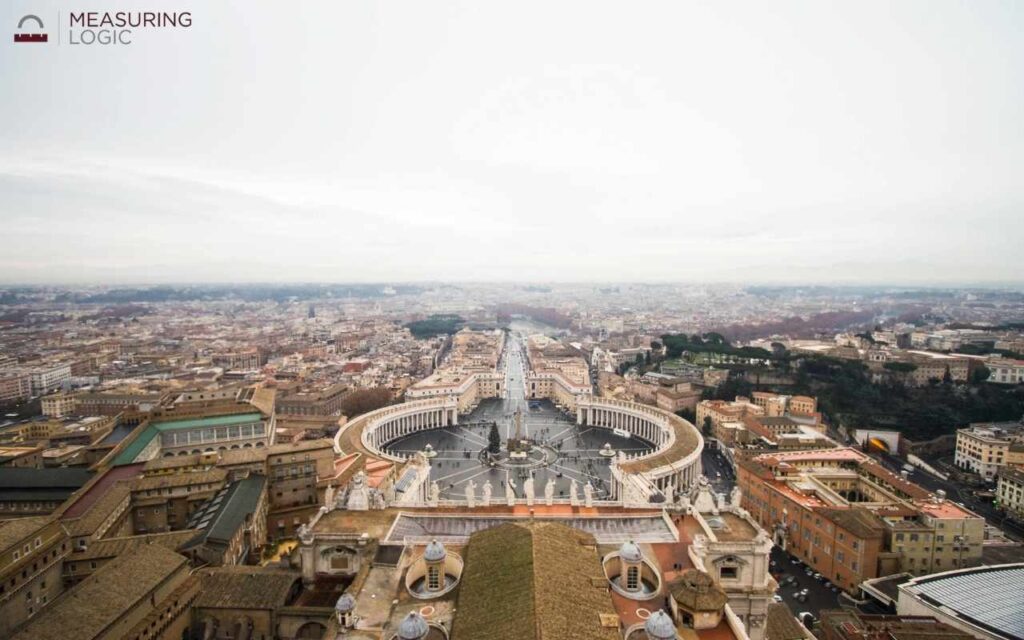
Numbers stick better when you attach them to something familiar. Here are a few reference points that land in the same range as 100 acres:
- Vatican City covers about 110 acres, making it almost exactly the size of the parcel you’re picturing.
- Disneyland’s original Anaheim park sits on roughly 85 acres, slightly smaller than 100 acres but close enough to picture the crowds it holds.
- A large public high school campus, including athletic fields and parking, often runs 30 to 50 acres, meaning two or three of them together would roughly match 100 acres.
- Central Park in New York spans about 843 acres, so 100 acres is roughly one-eighth of that entire park, still a serious chunk of green space in a dense city.
These comparisons matter more than raw math, because they turn an abstract number into something you can walk through in your imagination.
Is 100 Acres a Lot of Land?
The honest answer: it depends entirely on the context. 100 acres can feel massive or modest depending on what you’re comparing it to.
Compared to an Average House Lot
The median lot size for a new single-family home in the U.S. sits at about 8,543 square feet, or roughly 0.196 acres, according to Census Bureau data analyzed by the National Association of Home Builders. Do the math and:
100 acres ≈ 510 average house lots
That single number tells you almost everything about why 100 acres matters so much to residential developers. It’s not a yard, it’s a neighborhood.
Compared to a Typical Farm
Here’s a stat that surprises a lot of people: the average American farm in 2024 covered 466 acres, according to USDA figures. That means a 100-acre parcel is only about a fifth of what counts as an average-sized U.S. farm today. It’s a real working farm size, especially for specialty crops or smaller livestock operations, but it’s on the smaller end of American commercial agriculture.
Compared to a City Block
City blocks vary a lot by city, but a typical American block runs somewhere between 2 and 5 acres, depending on the street grid. Using a rough average of 3 acres per block:
100 acres ≈ 30 to 35 city blocks
That’s enough land to reshape an entire section of a downtown grid, which is exactly why large urban redevelopment projects get measured in acres rather than square feet.
The Bottom Line
For a backyard, 100 acres is an entire estate. For a housing development, it’s a solid mid-sized project and for a commercial farm, it’s on the smaller side. Is 100 acres a lot? For almost any use outside large-scale agriculture, yes, it’s substantial acreage.
42 INCHES DOES NOT SOUND MUCH UNTIL YOU PICTURE IT
What Can You Actually Do With 100 Acres?
A number this size only means something once you know what fits on it.
Farming and Ranching
For row crops like corn or soybeans, 100 acres is a legitimate, income-generating operation, though smaller than the national average farm. For grazing livestock, the math changes fast: depending on the region and forage quality, 100 acres of pasture might support anywhere from 20 to 50 head of cattle. Specialty operations, like vineyards, orchards, or organic vegetable farms, often thrive on far less land than 100 acres, which makes a parcel this size feel spacious by comparison.
Residential Development
This is where residential development conversations usually start. Using that average lot size of roughly 0.196 acres, a 100-acre parcel could theoretically support around 500 homes before accounting for roads, sidewalks, utilities, parks, and setbacks.
In practice, developers typically lose 25% to 35% of the land to infrastructure, so a realistic number lands closer to 300 to 400 homes on a well-planned 100-acre parcel. That’s a full subdivision, sometimes an entire small town’s worth of housing development.
Recreational or Conservation Land
Not every large tract of land needs to be built on or farmed. 100 acres of forest, wetland, or meadow can support hiking trails, hunting leases, wildlife habitat, or a private retreat property.
Conservation buyers and land trusts often target parcels in this exact size range because it’s large enough to matter ecologically but manageable enough to steward without a huge staff.
LEARN ABOUT COKE CAN DIMENSIONS
How Much Does 100 Acres Cost?
This is often the real question hiding behind the search, so here are current figures instead of a vague “it depends.”
According to the USDA’s 2024 Land Values Summary, the average value of U.S. farm real estate was $4,170 per acre, up 5% from the year before. That puts an average 100-acre parcel of farmland at roughly:
100 acres × $4,170 = $417,000
But that average hides huge regional swings. Here’s how the price shifts by land type and region:
| Land Type / Region | Price per Acre | Cost for 100 Acres |
|---|---|---|
| U.S. average (all farm real estate) | $4,170 | $417,000 |
| U.S. average cropland | $5,570 | $557,000 |
| U.S. average pastureland | $1,830 | $183,000 |
| Pacific region (CA, OR, WA) | $8,040 | $804,000 |
| Mountain region (lowest average) | $1,600 | $160,000 |
| Rhode Island (highest state average) | $22,000 | $2,200,000 |
What actually drives the price on a specific 100-acre parcel? A few factors matter more than anything else:
- Zoning: agricultural, residential, and commercial zoning all carry different price tags for identical acreage.
- Water access: irrigation rights or a reliable well can double the value of farmland.
- Road frontage and access: landlocked parcels sell for far less than land with direct road access.
- Proximity to a city: land near a growing metro area often prices closer to development value than farmland value, regardless of its current use.
As one land appraiser might put it, the acreage number only sets the floor. Everything else about the parcel decides how high the price actually climbs.
DISCOVER THE FASCINATING SIZE OF 500 FEET AND WHY IT MATTERS COMPARED TO EVERYDAY LANDMARKS.
Conclusion
100 acres works out to 4,356,000 square feet, 40.47 hectares, or about 0.405 square kilometers, but the number only becomes meaningful once you attach it to something real. It’s roughly 75 football fields, a 32-minute walk around the edge, and around 510 average house lots. It’s smaller than the average American farm, yet large enough to hold a full residential subdivision or a serious conservation property.
Whether 100 acres counts as “a lot” depends entirely on what you plan to do with it, and now you’ve got the real numbers to decide for yourself.
VISUALIZE 5 INCHES WITH OBJECTS
FAQs
How many football fields would it make? About 75 NFL football fields, including the end zones. Counting only the playing surface, that number rises to roughly 90.
How long would it take to walk around? If shaped as a square, the perimeter runs about 1.58 miles, which takes roughly 32 minutes at an average walking pace.
Is it enough for a farm? Yes, though it’s smaller than the U.S. average farm size of 466 acres. It works well for row crops, small livestock operations, orchards, and specialty farming.
How many houses can you build on it? Based on average U.S. lot sizes and typical infrastructure needs, a realistic estimate lands between 300 and 400 homes after accounting for roads and utilities.
What’s the difference between an acre and a hectare? A hectare is larger. One hectare equals about 2.47 acres, so 100 acres converts to roughly 40.47 hectares.
How much does does this much land cost? It varies widely by region and land type, but based on 2024 USDA averages, a typical 100-acre parcel of U.S. farmland costs somewhere between $160,000 and $804,000, with cropland and coastal regions priced higher than pastureland and inland regions.
HOW LONG IS 2 INCHES GET A MENTAL PICTURE

Hi, I’m Freddie Cove, the author for the Dimensions category at Measuring Logic. I create well-researched articles that explore the dimensions of everyday objects, products, and structures, helping readers compare sizes and find accurate, easy to understand information.