
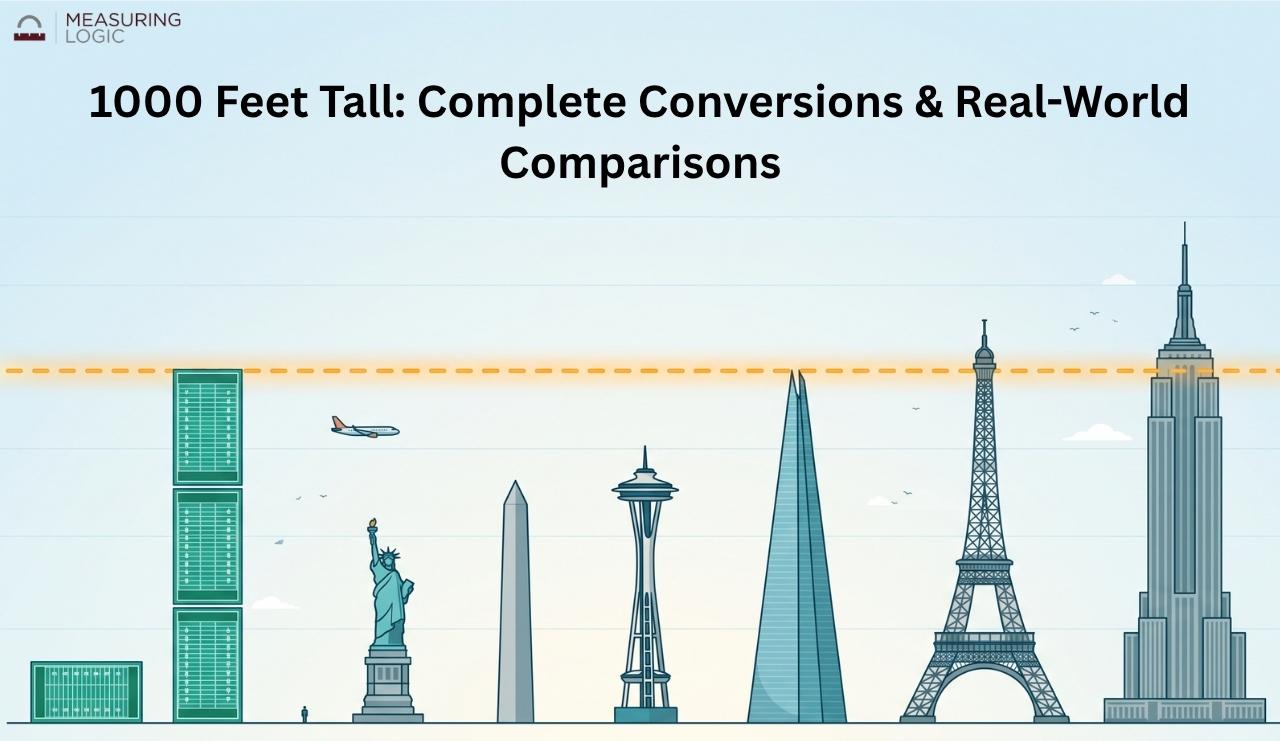
You’ve probably seen the number on a hiking map, a plane’s altimeter, or a skyscraper fact sheet. But how tall is 1000 feet when you stand at the bottom and look up? Numbers like this feel abstract until you tie them to something you know.
This guide fixes that. You’ll get exact conversions, real-life comparisons, famous buildings, travel times, and a height chart you can bookmark.
Quick answer: 1000 feet equals 304.8 meters. That’s about 3.3 football fields end to end and roughly 75 to 85 floors of a modern high-rise.
How Tall Is 1000 Feet? The Quick Answer
Let’s start with the math. The height of 1000 feet is exactly 304.8 meters. One foot equals 0.3048 meters by international agreement. So you multiply feet by 0.3048 and you’re done.
A fast mental shortcut also works. Divide the feet by 3 and subtract about 10 percent. For 1000 ft, that gives you roughly 300 meters.
1000 Feet in Meters and Other Units
You’ll see 1000 feet in meters all the time in global building heights. Most countries list tower heights in meters. This feet to meters metric conversion helps you compare an American skyscraper with one in Shanghai or Dubai.
Here’s the full length conversion for one thousand feet:
| Measurement Unit | Value |
|---|---|
| Meters | 304.8 |
| Kilometers | 0.3048 |
| Centimeters | 30,480 |
| Yards | 333.3 |
| Inches | 12,000 |
| Miles | 0.189 |
That last number matters for walking. One thousand feet is less than a fifth of a mile. You’ll cover that vertical distance in a very different way if you go up instead of across.
How Many Football Fields Is 1000 Feet?
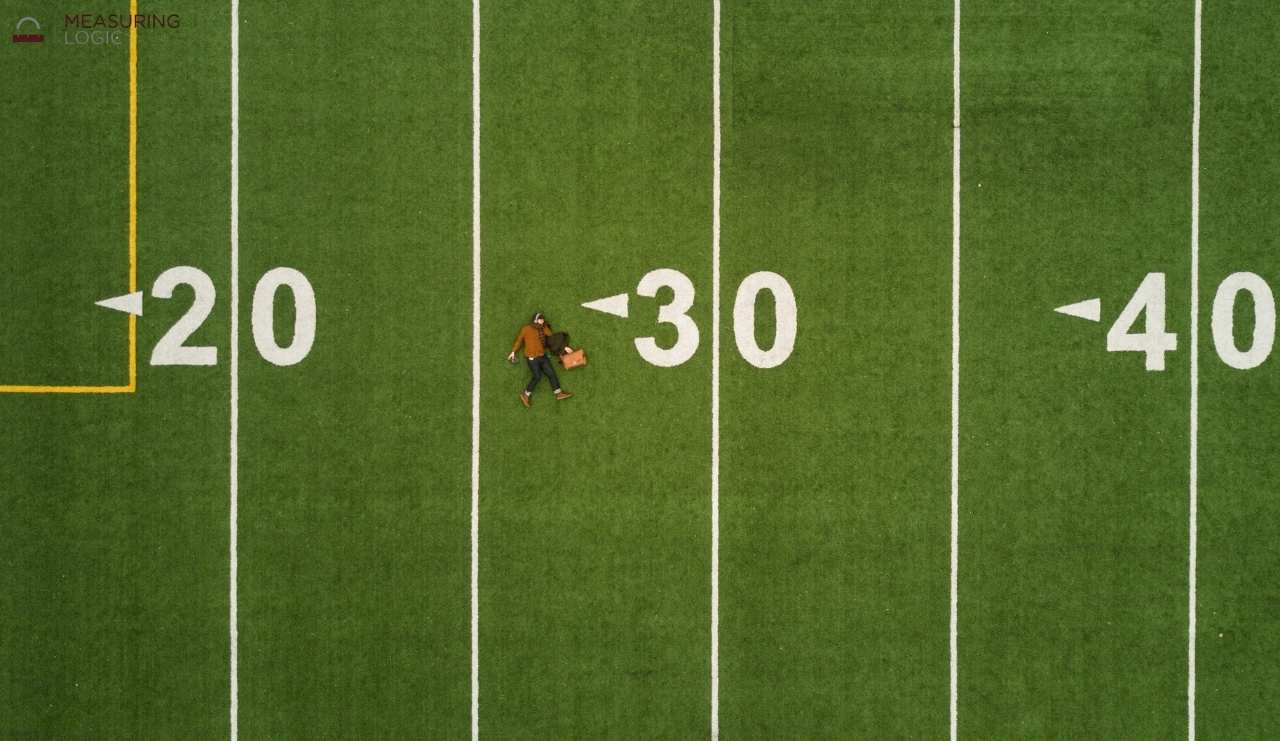
An American football field gives you the best visual height comparison. The playing field length between goal lines is 100 yards (300 feet). Add two 10-yard end zones and the full field stretches to 360 feet.
Here’s how the sports field dimensions stack up against a thousand-foot height:
- Goal line to goal line: 1000 ÷ 300 = 3.3 fields
- Including end zones: 1000 ÷ 360 = 2.8 fields
So three football fields stacked on end fall 100 feet short when you measure goal line to goal line. They overshoot by 80 feet when you include the end zones. Either way, you’re close.
Soccer fans can use a similar vertical comparison. International pitches run 100 to 110 meters long. That means 1000 feet equals about three pitches.
How Many Floors Is 1000 Feet?

The floor count for a 1000 feet height depends on how tall each floor is so there’s no single answer. A tall building with generous ceilings needs fewer floors to reach the same structural height.
The Floor Height Math
Floors vary a lot by building type. Here are typical architectural measurements:
| Floor Type | Typical Height |
|---|---|
| Residential | 9 to 10 feet |
| Office | 12 to 14 feet |
| Lobby or mechanical | 15 to 25 feet or more |
Now run the numbers for 1000 ft:
- At 10 feet per floor, you get 100 floors.
- At 12 feet per floor, you get about 83 floors.
- At 14 feet per floor, you get about 71 floors.
Most modern office towers land between 75 and 85 floors at this height.
A 100-story building usually stands well above 1000 feet. Most hundred-story skyscraper designs reach 1,200 feet or more. A 90-story tower often measures around 1,100 feet.
Real Buildings Show the Range
Real skyscraper dimensions prove the point. Look at how feet per floor changes from tower to tower:
| Building | Height (ft) | Floors | Feet per Floor |
|---|---|---|---|
| The Shard (London) | 1,016 | 72 | 14.1 |
| Chrysler Building (New York) | 1,046 | 77 | 13.6 |
| John Hancock Center (Chicago) | 1,127 | 100 | 11.3 |
| Empire State Building (New York) | 1,250 | 102 | 12.3 |
The Shard’s 72 count covers habitable floors only. The spire adds extra height with no floors at all.
Why Floor Counts Differ
Two buildings with the same tower height can have very different floor counts. Here’s why:
- Ceiling height: Luxury condos and trading floors need more room.
- Spires and antennas: They add height without adding floors.
- Mechanical levels: These tall, empty floors house equipment.
- Sky lobbies: They double the height of a single level.
- Counting rules: Some buildings skip numbers like 13.
Famous Buildings and Landmarks Close to 1000 Feet
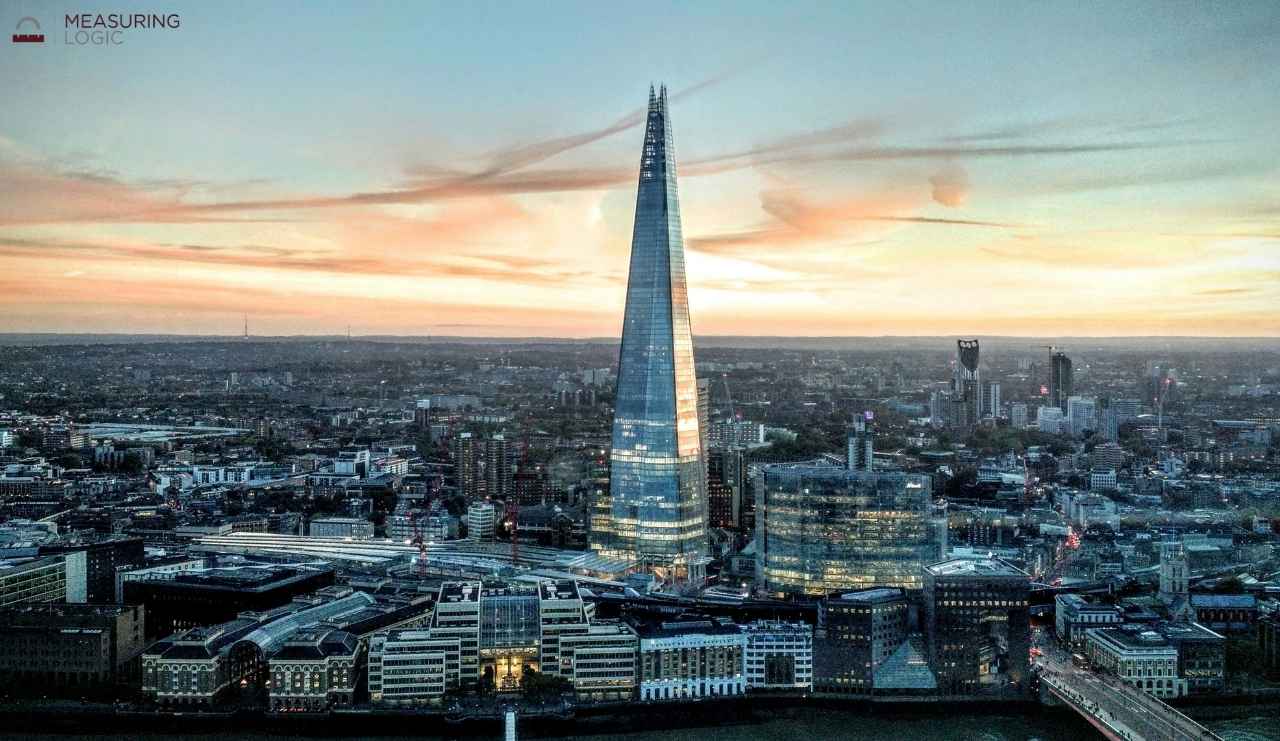
Several iconic skyscrapers and landmark structures sit right near the thousand-foot height. These familiar structures make the best everyday height examples.
Right Around the Mark
| Structure | Height (ft) | Height (m) |
|---|---|---|
| The Shard | 1,016 | 310 |
| Chrysler Building | 1,046 | 319 |
| Eiffel Tower (with antennas) | 1,083 | 330 |
| Tokyo Tower | 1,092 | 333 |
The Eiffel Tower deserves a note. When it opened in 1889, it became the first structure to pass 1,000 feet. Nothing built by humans had climbed that high before.
The Chrysler Building and The Shard still count as architectural landmarks today. Both clear the 300-meter line by a small margin.
Just Below 1000 Feet
These landmark structures fall short. They show the relative scale of what you’re picturing:
- Statue of Liberty (ground to torch): 305 feet
- Washington Monument: 555 feet
- Space Needle: 605 feet
- Gateway Arch: 630 feet
Stack the Washington Monument and the Statue of Liberty and you’d still reach only 860 feet.
Well Above 1000 Feet

The Empire State Building shows what 250 extra feet looks like. Its roof reaches 1,250 feet. Other supertall tower examples go much higher:
- Willis Tower (roof): 1,451 feet
- CN Tower: 1,815 feet
- Burj Khalifa: 2,717 feet
The Burj Khalifa stands 2.7 times taller than our target number. It’s still the world’s tallest building.
Real-World Comparisons: What Does 1000 Feet Look Like?
Numbers help. Pictures help more. If you’ve wondered what does 1000 feet look like, these real-world comparisons will build your height visualization.
| Object | Length or Height | How Many Fit in 1000 Feet |
|---|---|---|
| Six-foot person | 6 ft | about 167 |
| Average two-story house | 25 ft | 40 |
| School bus | 40 ft | 25 |
| Boeing 747-8 | 250 ft | 4 |
| Manhattan north-south block | 264 ft | 3.8 |
| Statue of Liberty (to torch) | 305 ft | 3.3 |
| Hyperion coast redwood | 380 ft | 2.6 |
| Blue whale (large adult) | ~100 ft | 10 |
That table gives you strong comparative measurements. A few extras help even more.
Cruise ships: Icon of the Seas measures about 1,198 feet long. Tip it upright and it stands taller than 1000 feet. The Titanic ran 882 feet. It would fall short.
Bridges: The Golden Gate Bridge’s towers rise 746 feet above the water. The Royal Gorge Bridge in Colorado hangs about 956 feet over the river. France’s Millau Viaduct has a mast that reaches 1,125 feet.
Wind turbines: The largest offshore turbines reach roughly 850 to 920 feet at the blade tip. A thousand-foot height would tower over almost all of them.
Here’s a simple way to see it. Stand at the bottom of a 1000-foot skyscraper and look up. The top sits roughly 80 floors overhead. Your neck bends back. Your eyes lose the details of the upper windows.
How Long Does It Take to Cover 1000 Feet?

Time changes with direction. A flat walk is trivial. A vertical ascent takes real effort.
Walking It Flat
At a normal pace of 3 mph, you walk 264 feet per minute so you cover 1000 feet in about 3.8 minutes. A runner at 6 mph does it in under two minutes.
Climbing Stairs
The climbing height matters here. With a standard 7-inch step, you’d climb about 1,714 stairs to gain 1000 feet. That’s a serious workout.
The Empire State Building Run-Up gives you a real benchmark. Racers climb 1,576 steps to the 86th floor. That’s about 1,050 feet of building elevation. Learn more at the Empire State Building site.
Taking an Elevator
Elevators cut the time dramatically:
| Elevator Type | Speed | Time to Rise 1000 Feet |
|---|---|---|
| Older mid-rise | 500 ft/min | 2 minutes |
| Burj Khalifa | 10 m/s | about 30 seconds |
| Shanghai Tower | 20.5 m/s | about 15 seconds |
Shanghai Tower runs one of the fastest elevators in the world. You’d rise 1000 feet in the time it takes to tie your shoes.
Hiking an Elevation Gain of 1000 Feet
Trails measure elevation gain, not distance. That’s your altitude difference from start to finish.
A common rule says you hike at 2 mph on flat ground. Then you add about 30 minutes for every 1,000 feet of climbing. This is Naismith’s rule.
Hard routes stretch the idea. Colorado’s Manitou Incline gains roughly 2,000 feet in under a mile. Hikers treat that hiking elevation as a serious test.
What Changes 1000 Feet Above the Ground?

A thousand feet up changes more than the view. You’re now in a different layer of air.
How Far You Can See
The horizon gets farther as you rise. A simple formula estimates the distance in miles: 1.22 × √height in feet. It ignores haze and terrain.
| Height | Distance to Horizon |
|---|---|
| 100 feet | 12 miles |
| 500 feet | 27 miles |
| 1,000 feet | 39 miles |
| 1,250 feet | 43 miles |
| 2,717 feet | 64 miles |
At 1000 feet, you could theoretically see a city 39 miles away. Clear air is the only catch.
Air Temperature and Pressure
Air gets cooler as you go up. Expect about 3.5°F less than at ground level. Air pressure falls too, by roughly 3.5 percent.
Observation Decks and Viewing Platforms
Many observation decks sit right around this elevated viewpoint. Here’s where you can enjoy panoramic city views:
| Observation Deck | Height (ft) |
|---|---|
| Shard View (London) | 800 |
| Top of the Rock (New York) | 850 |
| Eiffel Tower top level | 905 |
| Empire State Building, 86th floor | 1,050 |
| Edge, Hudson Yards (New York) | 1,100 |
| One World Observatory (New York) | 1,250 |
| Willis Tower Skydeck (Chicago) | 1,353 |
A skyscraper observatory at this height lets you spot landmark structures from far away. A good sightseeing tower shows you a city’s whole layout in one glance.
1000 Feet in Aviation and Regulations
Aviation rules give you another way to understand 1000 feet. Pilots treat this number as a safety buffer.
Under 14 CFR 91.119, aircraft over congested areas must stay at least 1,000 feet above the highest obstacle within 2,000 feet. That rule protects people on the ground.
A few other numbers help:
- Drone ceiling: Small drones can fly up to 400 feet above ground level in the US.
- FAA notice rule: Structures taller than 200 feet generally need FAA review.
- Marking and lighting: Tall towers follow FAA standards for paint and lights.
A typical airliner climbs through 1,000 feet in well under a minute after takeoff. You can read more on the FAA website.
Engineering Challenges of a 1000-Foot Skyscraper
Building a 1000-foot skyscraper isn’t just a matter of stacking floors. Height creates problems that shorter buildings never face.
Wind and Sway
Wind speeds rise with height. A tall tower catches stronger gusts. Engineers fight sway with a tuned mass damper. Taipei 101 uses a 660-ton steel sphere near its top to steady the building.
Elevator Technology
Elevators limit how tall a building can go. Long cables get heavy. Designers use sky lobbies where you switch elevators. They also use double-deck cars that carry two floors at once.
Lightning
Tall structures attract lightning. The Empire State Building takes roughly two dozen strikes a year. Lightning rods and grounding systems carry that energy safely down.
1000 Feet vs Other Heights: A Height Chart
This height chart gives you a quick size comparison. It shows height differences across common benchmarks:
| Height | Matching Landmark | Ratio to 1000 Feet |
|---|---|---|
| 100 feet | An 8 to 10 story building | 0.1× |
| 300 feet | Statue of Liberty (305 ft) | 0.3× |
| 500 feet | Great Pyramid (original 481 ft) | 0.5× |
| 1,000 feet | The Shard (1,016 ft) | 1× |
| 1,500 feet | Willis Tower roof (1,451 ft) | 1.5× |
| 2,000 feet | Shanghai Tower (2,073 ft) | 2× |
A few quick height differences stand out:
- The Empire State Building roof stands 250 feet taller.
- The Washington Monument stands 445 feet shorter.
- The Burj Khalifa stands 1,717 feet taller.
Is 1000 Feet Considered Tall?
Yes. By any standard, 1000 feet is a towering structure.
The Council on Tall Buildings and Urban Habitat (CTBUH) sets the official categories. A supertall tower reaches 300 meters or more and a megatall building reaches 600 meters or more.
Since 1000 ft equals 304.8 meters, it just clears the supertall line. That puts any 1000-foot skyscraper in an elite group. You can browse the full list at the CTBUH Skyscraper Center.
Many city skylines top out well below 500 feet. A tower twice that height dominates the view for miles. Architects care about the mark because it signals real engineering ambition.
Which Part Of Your Body Is Actually 7 Inches Long? Click To See The Fascinating Details.
Frequently Asked Questions About 1000 Feet
How High Is 1000 Feet in Meters?
It’s exactly 304.8 meters; therefore, you can multiply any feet value by 0.3048 for a quick feet to meters conversion.
Is a Football Field 1000 Feet?
No, a football field runs 300 feet between goal lines or 360 feet with end zones; as a result, you’d need about 3.3 fields to reach 1000 feet.
How Many Floors Is 1000 Feet?
Most buildings need 75 to 85 floors to reach 1000 feet; however, the exact floor count depends on ceiling height.
Discover the Engineering Genius Behind Red Bull Can Dimensions
How Far Is 1000 Feet to Walk?
It’s just under 0.2 mile; consequently, a steady walker covers it in about 3.8 minutes.
What Does 1000 Feet Look Like?
Picture three football fields end to end or the Shard in London; likewise, it matches about 80 floors of a typical office tower.
How Many Yards Is 1000 Feet?
It equals 333.3 yards; in other words, that’s more than three football fields between goal lines.
Try To Picture An Inch, You Will Be Fascinated How Common It Is Through This Guide.
Conclusion
So, how tall is 1000 feet? It’s 304.8 meters, about 3.3 football fields, roughly 80 floors, and close to a four-minute walk on flat ground. The Shard, the Chrysler Building, and the Eiffel Tower all sit near that line.
Now you’ve got the vertical measurement in your head with real pictures attached. Next time you see 1000 ft on a map or a spec sheet, you’ll know exactly what you’re looking at. Bookmark the conversion table and the height chart for quick reference.
Learn To Picture 2mm In Length Through Fascinating Examples
Sources and Further Reading
- CTBUH Skyscraper Center for building heights and floor counts
- Council on Tall Buildings and Urban Habitat for supertall and megatall definitions
- 14 CFR 91.119 for minimum safe altitudes
- FAA for drone and obstruction rules
- NIST for official measurement units
- Empire State Building for Run-Up and observatory details
See how 24 inches is engineered into everyday life.
Can You Guess What Measures 6 Inches? Click To See The List.

Hi, I’m Alice Arthur, the admin behind the Measurements category at Measuring Logic. I research, write, and review accurate measurement guides, unit conversions, and real-world comparisons to ensure every article is clear, reliable, and easy for readers to understand.