
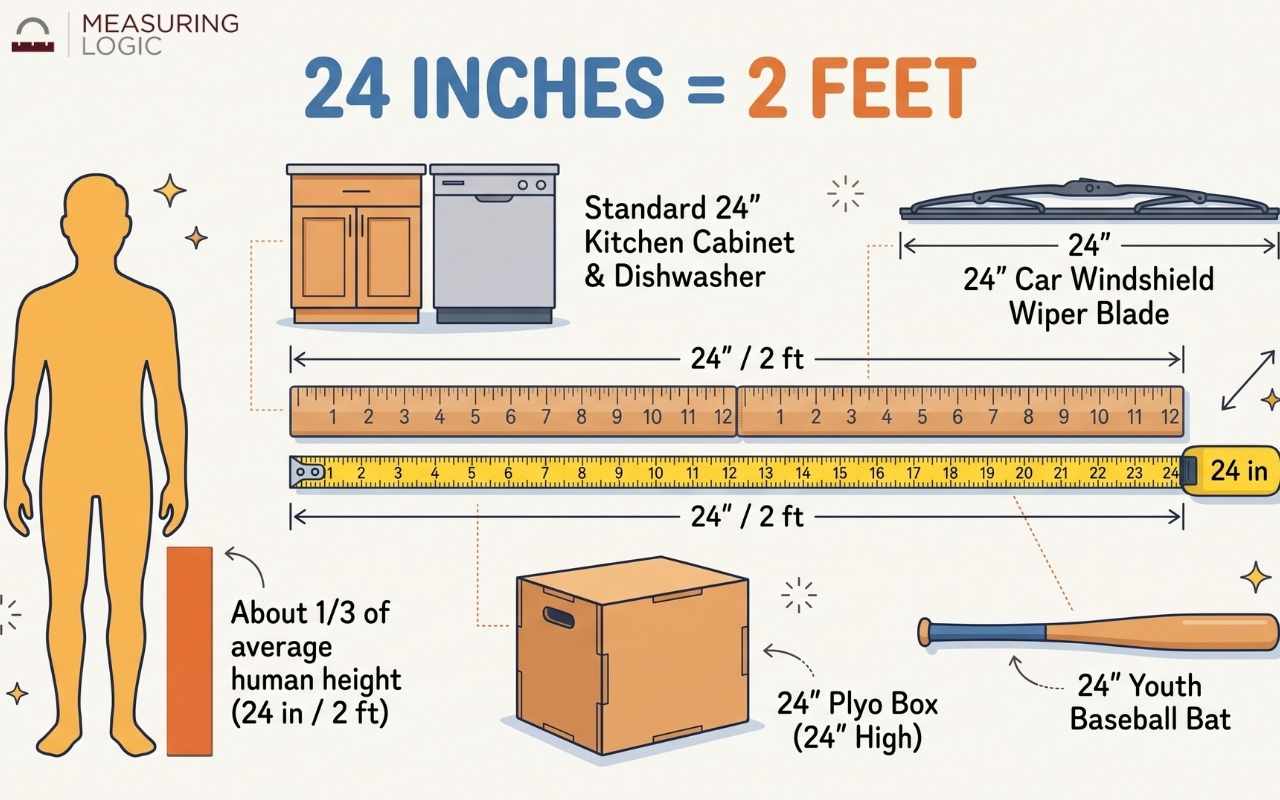
Quick answer: 24 inches equals 2 feet, which is exactly 60.96 centimeters. It covers about 35% of an average US man’s height and roughly the distance from your hip to just past your knee when you sit.
Picture two standard rulers end to end, and you have exactly 24 inches.
Numbers on a page rarely stick, though. A visual size guide works better, so this post ties 24 inches compared to human proportions and real products you can find at home or in a store.
How Much Is 24 Inches? Quick Facts and Unit Conversions
If you’ve wondered how much is 24 inches, start with the basics because the 24 inch measurement converts cleanly into every common unit.
| Unit | Value for 24 inches |
|---|---|
| Feet | 2 ft |
| Yards | 0.667 yd |
| Centimeters | 60.96 cm |
| Millimeters | 609.6 mm |
| Meters | 0.6096 m |
These conversions aren’t rounded guesses. In fact, since the 1959 international agreement, one inch equals exactly 25.4 millimeters. Therefore, if you multiply by 24, you get 609.6 millimeters with no leftover decimals, just as the NIST unit conversion page lists in its official factors.
Here’s a quick tip for mental math. A foot is about 30 centimeters, so two feet long lands near 60 centimeters. That shortcut gets you within 2% of the true figure.
24 Inches Compared to Human Body Measurements
Humans make great physical reference tools because we carry them everywhere but still, know that bodies vary a lot, so a good human size comparison needs real data instead of guesses.
How 24 Inches Compares to Average Adult Height
Start with human height. The CDC’s NHANES survey (2015–2018) put the average adult height in the US at about 69.1 inches for men and 63.7 inches for women. You can browse the data at the CDC NHANES site.
The math is simple:
- Adult male height: 24 ÷ 69.1 ≈ 35%
- Adult female height: 24 ÷ 63.7 ≈ 38%
So if you stacked three of these 24-inch bars, you’d stand a bit taller than most women and just above most men. Three bars add up to 72 inches, or 6 feet.
Worldwide, however, the average human height runs shorter. For example, a large study in eLife estimated global averages near 171 cm (67.3 in) for men and 159 cm (62.6 in) for women. By contrast, Dutch men averaged about 182.5 cm (71.9 in) in that same data set. Nevertheless, even there, 24 inches covers roughly a third of the body.
Body Measurements That Land Near 24 Inches

Which body measurement actually matches 24 inches?
Generally, three come close, and each one comes from anthropometric data such as the US Army’s ANSUR II survey. However, values shift slightly between data sets, so treat them as close estimates.
First, consider seated buttock-to-knee length.
Sit in a chair and measure from the back of your hips to the front of your kneecaps. On average, men reach around 24.5 inches, while women average around 23.6 inches. As a result, this is the best everyday match for the 24-inch size on the human body.
Second, look at shoulder to fingertip reach, at least in part.
A full shoulder-to-fingertip reach runs about 29 to 33 inches for most adults. Consequently, the first 24 inches or so gets you from the shoulder joint to just above the wrist. Specifically, for many men, it lands right at the wrist bone, whereas for many women, it reaches mid-hand.
Finally, there is mid-thigh height.
To measure this, stand straight and measure from the floor up. For an average adult, 24 inches reaches just above the kneecap at the lower thigh, even though true mid-thigh sits closer to 26 or 27 inches. Still, “floor to just above the knee” serves as a quick, practical reference.
In practice, taller people hit this marker lower on the leg, while shorter people hit it higher.
Here’s a simple way to picture it. First, stand next to a standard kitchen counter, which is usually 36 inches tall. From there, your 24-inch measurement reaches about two-thirds of the way up that counter.
Body Measurements That Aren’t 24 Inches
Plenty of guides blur this line. Several popular anatomical measurements look close to 24 inches but fall well short:
- Elbow to fingertip: about 17 to 19 inches
- Shoulder width: about 16 to 20 inches, depending on whether you measure bone or muscle
- Hand span (thumb to pinky): about 8 to 9 inches
- Natural walking step: about 26 to 30 inches, which is longer than 24
The elbow-to-fingertip mistake is common. Many people assume a forearm equals two feet. It doesn’t. Two forearms laid end to end come closer.
Body Measurement Table
| Body measurement | Typical adult male | Typical adult female | Gap vs. 24 in (male / female) |
|---|---|---|---|
| Standing height | 69.1 in | 63.7 in | 24 in is 35% / 38% of it |
| Seated buttock-to-knee | ~24.5 in | ~23.6 in | +0.5 in / −0.4 in |
| Shoulder to wrist | ~25 in | ~22.6 in | +1 in / −1.4 in |
| Elbow to fingertip | ~19 in | ~17 in | −5 in / −7 in |
| Shoulder (deltoid) width | ~19 in | ~17 in | −5 in / −7 in |
| Walking step | ~30 in | ~26 in | +6 in / +2 in |
All figures are approximate averages. Individual body size and body structure vary, so your own numbers could sit several inches higher or lower. Your torso length, arm span, and arm reach might not match the average at all.
24 Inches Compared to Babies and Children

Here’s a surprise. A lot of articles compare 24 inches to a toddler. That’s off by a wide margin.
According to the WHO growth standards, a baby reaches roughly 24 inches around three months old. A typical toddler stands closer to 33 or 34 inches by age two. You can check the charts at the WHO child growth standards and the CDC growth charts.
| Age | Median length or height (approx.) | How 24 in compares |
|---|---|---|
| Newborn | 19.5–20 in | 24 in is about 4 in longer |
| 3 months | ~24 in | About equal |
| 6 months | ~26 in | 24 in is about 2 in shorter |
| 12 months | ~29.5 in | 24 in is about 5.5 in shorter |
| 2 years | ~34 in | 24 in is about 70% of height |
| 4 years | ~40 in | 24 in is about 60% of height |
| 8 years | ~50 in | 24 in is under half |
Babies grow fast in the first year. Most gain about 10 inches between birth and their first birthday. That’s why a 24-inch visual comparison works for a newborn or young infant but fails for older kids.
Girls tend to reach 24 inches a few weeks later than boys. The difference is small, usually under an inch at three months.
How to Measure 24 Inches Without a Tape
No tape measure nearby? You’ve got options. Some are accurate. Others only get you in the ballpark.
Accurate methods:
- Two standard rulers. Each ruler runs 12 inches. Set them end to end for exactly 24. A standard ruler is the simplest measuring tool around.
- A yardstick. It’s 36 inches long, so 24 inches sits at the two-thirds mark.
- Four US dollar bills. Each bill is 6.14 inches long. Four in a row measure about 24.6 inches. That’s close enough for rough layout work.
Rough methods:
- Your seated leg. Measure your buttock-to-knee distance once with a real tape. Remember it. Now you carry a personal measurement reference.
- Your stride. Measure one natural step. Most adults land between 26 and 30 inches. Shorten it a little to estimate 24.
- Your arm. Measure from shoulder to wrist once. Many adults land within two inches of 24.
Body-based size visualization can drift by several inches from one person to the next. Calibrate once and you can trust it much more.
Things That Are 24 Inches: Everyday Objects With a Real Standard
Looking for things that are 24 inches? Stick with items that follow a published standard. That way your real-world size reference works in any home or store.
| Object | Why it counts |
|---|---|
| Base kitchen cabinet (depth) | Standard depth is 24 in |
| Built-in dishwasher (width) | Standard width is 24 in |
| Wall stud spacing | Studs sit 16 or 24 in on center |
| Floor and ceiling tiles | 24 × 24 in is a common size |
| Windshield wiper blade | 24 in is a standard replacement size |
| Plyo (box jump) box | 24 in is a common height option |
| Counter-height stool | Seat height typically runs 24–27 in |
| Zip tie (long type) | 24-in cable ties are sold widely |
Here’s a closer look at the most useful ones.
Kitchen Storage and Cabinet Dimensions

Kitchen storage follows tight rules. Specifically, base cabinets stand 34.5 inches tall and sit 24 inches deep. In addition, countertops add about 1.5 inches of overhang on top. Ultimately, these standard cabinet dimensions let appliances slide in without gaps.
Upper cabinets, on the other hand, work differently. For instance, they are usually only 12 inches deep, while cabinet height for upper units often comes in 30, 36, or 42 inches. Additionally, some makers sell 24-inch-tall units for spots above refrigerators or short walls.
Furthermore, a kitchen cabinet door doesn’t have one fixed size. Instead, door width and height depend entirely on the cabinet box. Therefore, don’t use a cabinet door as a 24-inch dimension reference unless you’ve measured it yourself.
Dishwashers, Studs, and Tiles

A standard built-in dishwasher is 24 inches wide. Builders design the cabinet run around that number.
Wall studs are spaced 16 or 24 inches on center in most US homes so if you’ve ever hung a heavy shelf, you’ve used this 24-inch measurement without knowing it.
Floor and ceiling tiles also come in 24 × 24 inch squares. They’re popular because fewer grout lines make a room look larger.
The Windshield Wiper Blade

A 24-inch wiper is one of the most common sizes on the market. However, wiper length varies by car, though most passenger vehicles use blades between 14 and 28 inches. In fact, the driver’s side often takes a longer blade than the passenger side. For instance, a 24-inch wiper on one side might pair with an 18- or 19-inch wiper on the other.
Therefore, when you buy a replacement blade, always check your owner’s manual or the retailer’s fit guide first.
Sports and Fitness Gear

A 24-inch baseball bat is typically a youth or practice bat. In fact, T-ball players around age four or five often swing one, whereas adult bats usually run closer to 31 or 34 inches.
That makes a youth baseball bat at 24 inches a good real-life example of the two-foot mark in sports equipment.
A plyo box is another solid reference. Most gyms stock a 24-inch height for box jumps so it is a clean way to see the vertical measurement in action. Jump onto it and you’ve cleared two feet.
Compact Seating and Counter Stools
A counter-height stool has a seat that sits 24 to 27 inches off the floor.
That’s higher than a dining chair at about 18 inches. It’s also lower than a bar stool, which usually runs 28 to 32 inches. Compact seating like this makes a handy household reference because you probably have one.
Things People Wrongly Call 24 Inches

Many lists mix real standards with items that only sound right. Here’s where readers get tripped up.
The 24-Inch Monitor
A 24-inch monitor doesn’t measure 24 inches across. The number describes the diagonal of the 24-inch screen. For a standard 16:9 display, the screen dimensions work out like this:
- Width: about 20.9 inches
- Height: about 11.8 inches
For a 16:10 panel, width drops to about 20.4 inches and height rises to about 12.7 inches.
There’s another catch. Many models sold as 24-inch are really 23.8 inches so always check monitor size by the diagonal, then look up the width. A computer monitor that “is” 24 inches only fits in a 24-inch gap if you measure the stand and bezels too. Small TVs follow the same diagonal rule.
The Carry-On Suitcase
A 24-inch bag is usually not a carry-on suitcase. Most major US airlines cap carry-on luggage at about 22 × 14 × 9 inches, including handles and wheels. That limit is built around the overhead compartment.
Suitcase height also trips people up. A bag labeled “24 inches” may measure 25 to 27 inches with wheels attached. It’s a medium checked bag in most brands. Luggage size rules differ by airline, so check yours before you fly.
When Knowing What 24 Inches Looks Like Actually Helps
You won’t carry a tape measure everywhere. A solid sense of the 24-inch size pays off in everyday situations.
- Furniture and appliance fit. Check doorways, stair turns, and cabinet gaps. A 24-inch dishwasher needs a 24-inch opening.
- Home projects. Plan stud spacing, tile layout, and shelf supports around 24-inch intervals.
- Travel. Compare your bag’s real luggage size with your airline’s limits.
- Online shopping. Listings mix diagonal, width, and length. Know which one the seller means.
- Fitness. Pick a plyo box height that matches your jump level.
Try To Picture An Inch, You Will Be Fascinated How Common It Is Through This Guide.
A Short History of the Inch and Foot
People measured with their bodies long before rulers existed. The foot started as the length of a human foot. The cubit ran about 18 inches, roughly the distance from elbow to fingertip. That’s why an anatomical proportions measurement like a forearm ended up so close to a unit.
The system stayed loose for centuries. In 1959 the US, UK, and other countries agreed on the international yard. That fixed the inch at exactly 25.4 millimeters so every 24 inch length you see today traces back to that deal.
Learn How Long Is 5 Inches For Visualization
Quick Comparison Table: 24 Inches vs. Common References
| Reference | Size | Difference from 24 in |
|---|---|---|
| Adult male height (US) | 69.1 in | +45.1 in |
| Adult female height (US) | 63.7 in | +39.7 in |
| Three-month-old baby | ~24 in | About 0 |
| Standard ruler | 12 in | −12 in (two rulers = 24) |
| Yardstick | 36 in | +12 in |
| Base cabinet depth | 24 in | 0 |
| Dishwasher width | 24 in | 0 |
| 24-inch monitor width | ~20.9 in | −3.1 in |
| Carry-on size limit (long side) | ~22 in | −2 in |
| Skateboard deck | ~31–33 in | +7 to +9 in |
Learn To Picture 2mm In Length Through Fascinating Examples
Frequently Asked Questions
How long is 24 inches in feet and centimeters?
It’s exactly 2 feet and 60.96 centimeters.
How big is 24 in compared to a person?
It’s about 35% of an average US man’s height and 38% of an average woman’s. It’s also close to the seated distance from hip to knee.
What household item is 24 inches long?
A base kitchen cabinet is 24 inches deep. A built-in dishwasher is 24 inches wide. Two standard rulers laid end to end also match.
How wide is a 24-inch monitor?
A 16:9 monitor measures about 20.9 inches wide. The 24 inches refers to the diagonal.
Is a 24-inch bag a carry-on?
Usually not. Most airlines limit carry-ons to about 22 inches in length. Check your airline’s rules before you pack.
How long is 25 inches visually?
It’s one inch longer than two feet. Think of a 24-inch bar with a paperclip added.
Learn To Visualize 3 Inches Through This Guide
Final Thoughts
Two feet is easier to picture than it sounds. Remember that 24 inches equals about 35% of an average man’s height. It’s close to your seated hip-to-knee distance. And it’s the depth of a standard kitchen base cabinet.
When in doubt, grab two 12-inch rulers. They’re the cleanest way to see how long 24 inches really is.
Learn How Big 100 Acres Is (And Why It’s So Fascinating)
How Long Is 13 Inches? Click To See 18 Everyday Objects For Comparison

Hi, I’m Alice Arthur, the admin behind the Measurements category at Measuring Logic. I research, write, and review accurate measurement guides, unit conversions, and real-world comparisons to ensure every article is clear, reliable, and easy for readers to understand.