
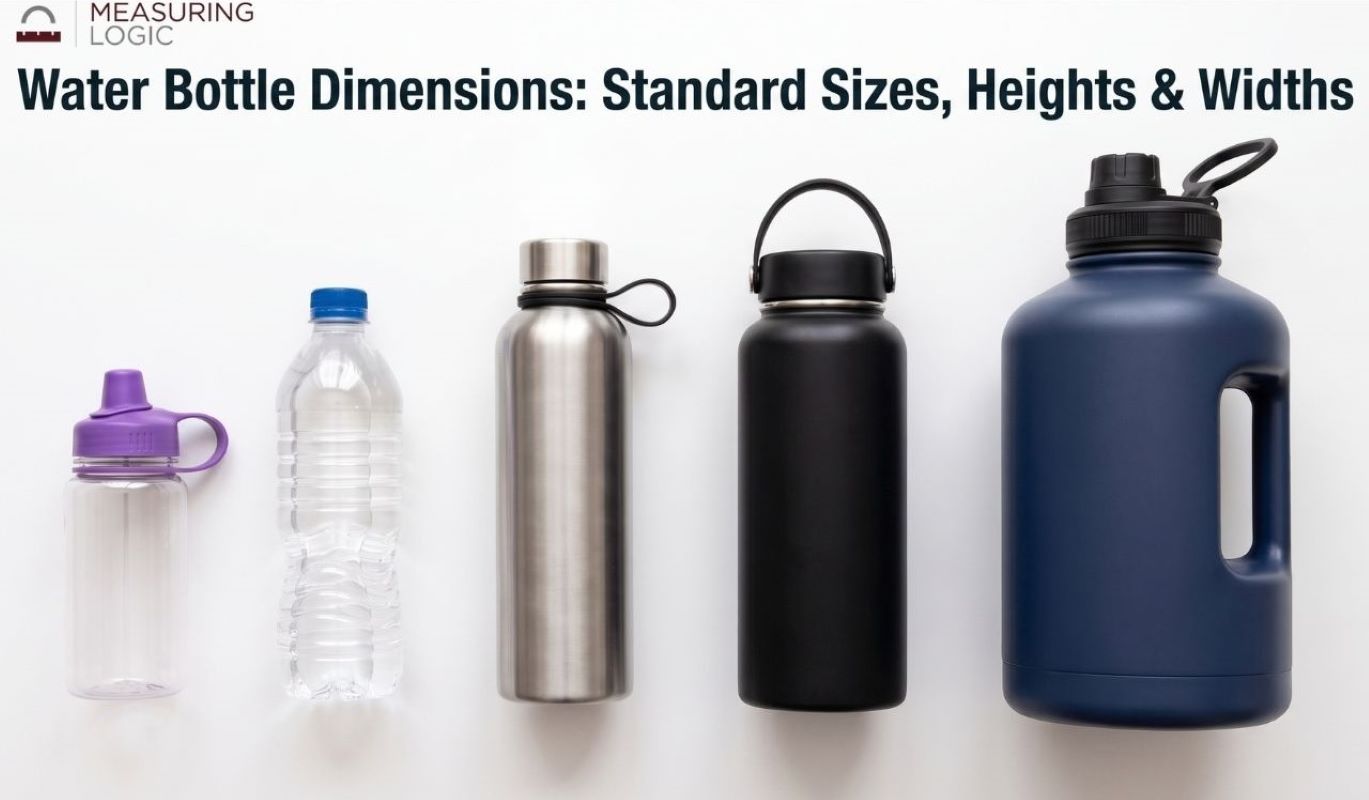
Water bottles have always been in our daily life especially during our school days when cool boys always had the more fancy ones. Since we use them even today this guide breaks down water bottle dimensions across every common material and capacity, so you know exactly what you’re buying, packing, or designing around.
Quick Answer: Standard Water Bottle Sizes by Capacity
Most standard water bottle sizes fall into a handful of common capacities. Below is a breakdown of typical water bottle height and diameter for each, based on widely available products.
| Capacity | Typical Height | Typical Diameter | Common Category |
|---|---|---|---|
| 8 oz (237 ml) | 4–5 in | 2 in | Kids/travel |
| 12 oz (355 ml) | 5–6 in | 2.3 in | Small beverage bottle |
| 16.9 oz (500 ml) | 8–8.3 in | 2.5 in | Standard size bottled water |
| 20 oz (591 ml) | 7.5–8 in | 2.8 in | Gym/everyday |
| 24 oz (710 ml) | 9–10 in | 2.8 in | Sports bottle |
| 32 oz (1 liter) | 9–10.5 in | 3.3–3.5 in | 1 liter water bottle |
| 40 oz (1.18 liter) | 10.5–11.5 in | 3.5 in | Large tumbler-style |
| 64 oz (1.9 liter) | 12–13 in | 5.5 in | Jug-style hydration bottle |
These numbers vary by brand, but they give you a solid baseline for water bottle inches across the board.
Why Water Bottle Dimensions Matter
A bottle’s water bottle size affects way more than how much it holds. It determines whether it fits in your car’s cup holder, your backpack’s side pocket, or your bike’s water cage. Product designers care about container dimensions for shipping and shelf space. Parents care about bottle height and weight for what their kids can actually lift.
Here’s the tricky part: capacity and size don’t scale together in a simple way. A 32 oz insulated steel bottle can be shorter and wider than a 24 oz plastic one. Bottle measurements depend on shape, wall thickness, and material, not just volume.
How Many Inches Is a Water Bottle?
This is one of the most common questions people search, and the honest answer is: it depends on the bottle. But if you want a quick reference, here’s what to expect.
A 16.9 oz water bottle, the size you’d grab off a store shelf, usually measures 8 to 8.3 inches tall with a diameter around 2.5 inches. That’s the classic single-serve disposable bottle shape you see everywhere from vending machines to gas stations.
If you’re asking how many inches in a water bottle for a larger 32 oz size, you’re looking at roughly 9 to 10.5 inches in height. Insulated steel versions run a bit shorter and wider because of the double-wall vacuum gap, which adds bulk without adding much length.
Quick rule of thumb: for every 16 oz jump in capacity, expect the height to increase by roughly 1 to 1.5 inches, assuming the diameter stays similar.
How Long Is a Water Bottle?
“Length” and “height” get used interchangeably here, since most bottles stand upright rather than lie flat. When people ask how long is a water bottle in inches, they usually mean the vertical measurement from base to cap.
For a regular bottle in the 16–20 oz range, that’s typically 7.5 to 8.5 inches. Add a sport cap or flip-top lid, and you’ll tack on another half inch to a full inch, depending on the design.
Bottle length becomes especially important for:
- Backpack side pockets — most fit bottles up to 10–11 inches
- Bike water cages — standard cages accommodate 7–10.5 inches
- Lunch boxes — usually cap out around 8 inches
Standard Water Bottle Dimensions Chart
Here’s a more detailed water bottle dimensions chart comparing material types at the same capacity, since bottle specifications shift noticeably depending on what the bottle’s made from.
| Material | 20 oz Height | 20 oz Diameter | Notes |
|---|---|---|---|
| Plastic (PET) | ~8–8.5 in | ~2.7 in | Thin walls, lightweight |
| Stainless steel (insulated) | ~8.7–9.5 in | ~2.9–3.1 in | Double-wall adds width |
| Glass | ~7.5–8 in | ~3 in | Shorter, sturdier base |
| Collapsible silicone | ~7 in (expanded) / 2 in (folded) | ~3 in | Flattens for storage |
Plastic Water Bottle Dimensions

Plastic water bottle dimensions are the most standardized in the industry, mostly because bottling companies optimize for shipping efficiency. A PET bottle, the kind used for most disposable bottle water products, follows tight manufacturing tolerances.
Here’s what you’ll find across popular bottled water brands:
- 16.9 oz (500 ml) — roughly 8 inches tall, 2.5 inches wide
- 20 oz (591 ml) — roughly 8.25 inches tall, 2.6 inches wide
- 33.8 oz (1 liter) — roughly 10.5 inches tall, 3 inches wide
- 1 gallon jugs — roughly 11 inches tall, 6 inches wide at the base
Reusable plastic bottle options, like Nalgene-style wide-mouth bottles, run a bit stockier. A 32 oz Nalgene measures about 7.75 inches tall and 3.4 inches wide, prioritizing durability and easy refilling over slim portability.
Water Bottle Weight
Water bottle weight depends heavily on material, and the difference is bigger than most people expect.
| Material | Empty Weight (20 oz size) | Filled Weight (20 oz size) |
|---|---|---|
| Plastic (PET) | 0.5–1 oz | ~21 oz |
| Stainless steel | 10–14 oz | ~31–35 oz |
| Glass | 8–10 oz | ~29–31 oz |
| Aluminum | 3–4 oz | ~24 oz |
That gap matters if you’re hiking or carrying a bottle all day. An empty bottle weight of under an ounce for plastic versus over 10 ounces for steel adds up fast when you’re filling multiple bottles for a trip. The trade-off, of course, is insulation. Steel keeps drinks cold for hours; plastic doesn’t.
Learn How Big 100 Acres Is (And Why It’s So Fascinating)
How Many Water Bottles Is 1 Liter?
This one comes up constantly when people are tracking daily water intake. A 1 liter water bottle holds about 33.8 fluid ounces. Here’s how that breaks down against common bottle sizes:
- 16.9 oz bottles: it takes exactly 2 bottles to reach 1 liter
- 500 ml bottles: same as above, 2 bottles equal 1 liter
- 16 ounce bottle: about 2.1 bottles
- 8 oz bottles: it takes 4.2 bottles
For quick daily tracking, most people round it to “two half-liter bottles equal one liter,” which holds up well enough for practical use. If you’re using a half-liter bottle as your go-to size, just remember two refills gets you to that 1-liter mark.
How Long Is 13 Inches? Click To See 18 Everyday Objects For Comparison
How to Measure a Water Bottle Correctly
If you’re measuring your own hydration bottle for a cup holder, backpack pocket, or custom label, do it this way:
- Height: measure from the base to the top of the cap, not just the neck opening
- Diameter: measure at the widest point of the body, since necks taper inward
- Capacity: check the printed volume, but note that “fill line” capacity is often less than the bottle’s max volume
Skipping this step is the number one reason people buy a beverage bottle that doesn’t fit where they need it to.
Learn To Picture 2mm In Length Through Fascinating Examples
Choosing the Right Bottle Size

Different situations call for different container dimensions. Here’s a quick guide:
- Daily carry/office: 16–20 oz, slim profile for desks and bags
- Gym: 24–32 oz, wide mouth for ice and quick refills
- Hiking/backpacking: 32 oz+, insulated, built for durability
- Kids: 8–12 oz, lightweight and easy to grip
LEARN ABOUT GATORADE BOTTLE DIMENSIONS
Conclusion
Water bottle dimensions aren’t one-size-fits-all, and now you know exactly why. From an 8-inch-tall standard 16.9 oz bottle to a 13-inch jug-style hydration bottle, size depends on capacity, material, and design purpose. Use the charts above as your go-to reference the next time you’re shopping, packing, or designing around a water bottle.
LEARN ABOUT COKE CAN DIMENSIONS
FAQs
How many inches is a standard water bottle?
A standard 16.9 oz plastic bottle measures about 8 to 8.3 inches tall.
How many ounces is a standard water bottle?
Most standard water bottle sizes range from 16.9 oz to 20 oz for single-serve options.
How many water bottles equal 1 liter?
Two 16.9 oz (500 ml) bottles equal roughly 1 liter (33.8 oz).
What’s the average diameter of a water bottle?
Most bottles in the 16–20 oz range measure between 2.5 and 2.8 inches in diameter.
Do all 16.9 oz bottles have the same dimensions?
No. Brand-specific shapes cause slight variation, but most fall between 7.8 and 8.3 inches tall.
Try To Picture An Inch, You Will Be Fascinated How Common It Is Through This Guide.

Hi, I’m Alice Arthur, the admin behind the Measurements category at Measuring Logic. I research, write, and review accurate measurement guides, unit conversions, and real-world comparisons to ensure every article is clear, reliable, and easy for readers to understand.